Should you hire a consultant for your charter renewal?
A renewal package demands time, specific expertise, and outside perspective. When hiring a consultant is worth it, when it is not, and the first step you can run yourself either way.
Adam Aberman
CEO & Founder
Most schools ask this question about four months before their renewal is due, which is usually the point at which the size of the package becomes real. It is a fair question and the honest answer is that it depends on which of three things you are actually short of.
A renewal package demands time, specific expertise, and outside perspective. Schools tend to talk about the first, quietly struggle with the second, and rarely notice the third until a reviewer points at something everyone inside the building had stopped seeing.
When a consultant is worth it
Bring one in when you are short on expertise you will not need again. If your authorizer has changed its framework since your last renewal, or you are facing your first renewal under new leadership, or there is a finding from a prior cycle you have to demonstrate you closed, that is specialised knowledge with a narrow shelf life. Hiring it is usually cheaper than building it.
Bring one in when the stakes are unusually high. A school with a prior notice of concern, a material audit finding, or enrollment on a downward trend is not in a normal renewal. The cost of a weak package in that situation is not a worse score, it is the school.
Bring one in when nobody inside can be objective. This one is underrated. The people who built the programs are the people writing about the programs, and they are the worst possible readers of their own evidence. An outsider who has read a hundred of these will see in twenty minutes what the founding team cannot see at all.
When it is not worth it
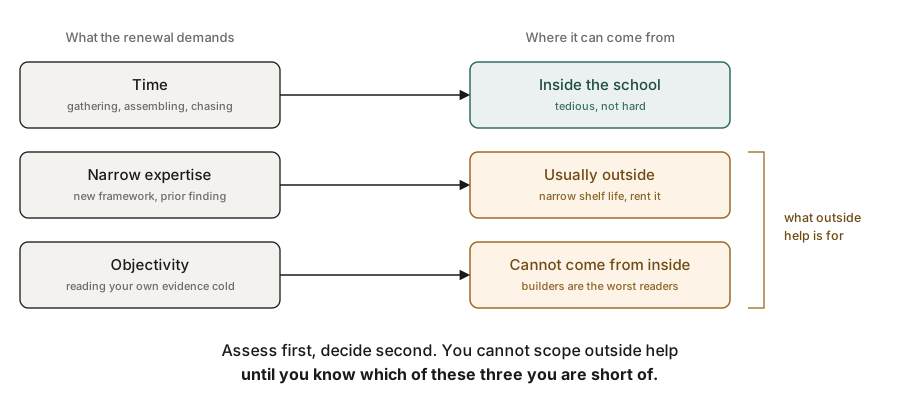
What a renewal actually demands, and where each part can come from.
Do not hire one to solve a documentation problem. If the real issue is that board minutes from two Octobers ago are somewhere in a shared drive and last year's audit is with the business manager, a consultant will spend billable weeks doing what your office manager could do with a list and a deadline. That work is tedious, it is not hard, and paying consulting rates for it is the most common way schools overspend on renewal.
Do not hire one to write claims you cannot evidence. A well-written narrative around thin evidence reads worse than a plain one, because reviewers have seen the polished version many times and know what it usually covers. If the underlying evidence is missing, the fix is evidence.
Do not hire one because you are behind schedule. Bringing an outsider in late means paying someone to learn your school during the weeks you needed for assembly. Consultants add the most value early, when there is still time to act on what they find.
The part you can do either way
Whatever you decide, the first step is the same, and it is one you can run yourself: find out what your own evidence looks like to someone who does not work at your school.
That means gathering what a reviewer would gather without asking you for anything, which is your public footprint. The website, the plans posted on it, the board packets, the audited financials. Then read it as though you had never been in the building. Most schools discover two kinds of gaps in that pass. Documents that are missing, and documents that are present but say something the school stopped believing three years ago.
You will find some of it uncomfortable. That is the point, and it is much better to find it in July than to have a reviewer find it in November.
If that pass turns up a handful of missing documents and some stale plans, you probably have a project rather than a crisis, and your own team can run it. If it turns up structural problems in governance, finance, or academic evidence, that is when outside help earns its cost, and you will now be able to brief that help precisely instead of paying them to discover the same thing.
What we do, so you can discount it accordingly
We build software that runs that first pass automatically. We have an obvious interest in you deciding you can handle renewal without a consultant, and you should weigh what you just read with that in mind.
What we would say regardless is that the sequence matters more than the choice. Assess first, decide second. You cannot scope an engagement for a problem you have not identified, so a school that assesses first either briefs its consultant precisely or discovers it did not need one. A school that hires first is paying an expert to find out what is wrong, which is the most expensive way to learn it.
Ready to see it in action?
Upload your school documents and get a comprehensive quality report.
Take the Assessment